

Goal: centralize reliable, practical paths for building a lively, balanced program. This directory page guides your artistic and teaching choices.
Context: the post-“Les Choristes” enthusiasm revived collective singing in France. Specialized shops such as Stretta Music and Editions A Coeur Joie offer PDF formats, printed editions and fast shipping.
Here you will find an overview of catalogs, downloadable scores and clear information on delivery times and prices. Offers often start at EUR 2.00 and provide direct access to works from Desprez to Poulenc.
What you can do: browse by composer, sort from Name A to Z, check levels and quickly identify prices. The site brings together references for amateur and professional ensembles.
The listings detail scoring for mixed voices, a cappella or accompanied writing (piano, organ) and SATB forces. Follow this repertoire regularly to enrich vocal color and vary styles.
French Song Repertoire for Choir
Find here a practical selection of arrangements and scores suited to mixed ensembles.
The classics of Brel, Brassens, Nougaro and Gainsbourg offer rich ground for harmonizing familiar melodies. La chanson des vieux amants or Quand on n’a que l’amour allow the use of countermelodies and dramatic phrasing.
The contemporary scene and slam add depth. Titles such as Je ne mache pas mes mots (Camille) and Toucher l’instant (Grand Corps Malade) require careful diction and groove.
“Alternating full ensembles and internal solos enriches the color and highlights each section.”
| Title | Author | Format | Musical interest |
|---|---|---|---|
| Les sabots d’Helene | Brassens | SATB + piano | Countermelodies, harmonic simplicity |
| Toulouse | Nougaro | A cappella / piano | Syncopations, swing |
| Leve-toi | Barbara Pravi | Adaptation for mixed voices | Intense phrasing, expressiveness |
Many scores are available for immediate download, often at low prices. To explore SATB choir editions and online score resources, see an informational catalog such as ChoralWiki choral score catalog.
French Song for Choir: From Essentials to Rare Gems
To build a lively set, combine a broad ballad, a poetic piece and a syncopated number. This route keeps the audience engaged and makes interpretation work easier.
Concert-hall standards
Quand on n’a que l’amour offers an ideal dynamic arc for an opening or encore.
Syracuse lets singers work on prosody and the inner color of the sections.
Le jazz et la java requires respect for swing and great rhythmic precision.
Humor and wit
Include a few Boris Vian titles, such as On n’est pas la pour se faire engueuler or Fais-moi mal Johnny, to lighten the atmosphere.
These pieces train diction and articulation, useful for all voices.
- Interpretation tips: arched dynamics, clear prosody, section/lead balance, respect for swing.
- Orchestration: SATB a cappella or SATB with piano; plan alternating solos for relief.
- Teaching: begin with an expressive unison, unify vowels and place consonants for projection.
Available scores give a good preview of range and verse structure. Alternate expected hits and rare gems to surprise without losing the audience’s support.
Sacred and Classical Works Adapted for Ensembles
Sacred and classical works bring valuable contrasts that structure any vocal program.
Contemporary triptych:
Jenkins: Agnus Dei, In Paradisum, Adiemus
This Jenkins trio combines soaring atmospheres and modern rhythms. It lets the choir explore collective resonance and vowel color.
French Romantics and Moderns
Faure, Gounod, Poulenc and Ravel strengthen legato line and nuance. These works demand vocal precision and finesse in modal cadences.
“Alternating sacred and modern pieces refines the ear and enriches the ensemble’s expressive palette.”
Formats and Practical Uses
Available formats: piano reductions, SATB scores with organ, a cappella options.
| Work | Common format | Interest |
|---|---|---|
| Cantique de Jean Racine (Faure) | Piano reduction / SATB | Legato, dynamic control |
| Messe breve no. 7 (Gounod) | SATB + organ | Classical cadences, section balance |
| Agnus Dei (Jenkins) | A cappella choir / piano | Contemporary colors, resonance |
- Teaching benefits: intonation on slow chords, vowel work and soprano/bass balance.
- Stage tip: link a vocal piece and a modern excerpt to sustain attention.
- Availability: previews and downloadable scores from EUR 2.00, or shipping in 2 to 5 days for piano reductions.
World Music in Service of Your Choir
A dedicated world music module brings energy, rhythms and new vocal colors to the program. It encourages orality, linguistic diversity and the highlighting of natural timbres.

Southern Africa: titles such as Siyahamba, Shosholoza and Aya Ngena serve as workshops in energetic unison, call-and-response and accessible polyrhythm. These pieces exist in SATB, SSA or TTBB arrangements, often a cappella.
The Americas and Europe: Oh Shenandoah brings a lyrical line, La Bamba a festive energy, and Con el vito works rhythmic agility. Together, they balance the program and offer a fine preview of global colors.
- Start with SSA/TTBB before approaching full SATB to establish cohesion.
- Watch the precision of ostinatos and the clarity of consonant attacks.
- Online scores often offer a cappella versions and body-percussion tracks.
Respecting original languages and accents enriches projection and color. Adding one or two world pieces as an opener or encore brings the audience together and strengthens the collective confidence of mixed voices.
Mixed Voices, Equal Voices, TTBB: Choosing the Right Scoring
Choosing the right vocal scoring begins with a simple diagnosis of numbers and ranges.
Count the S/A/T/B distribution, note the outer ranges and check attendance stability. This helps guide the ensemble toward SATB, SSA or TTBB without surprises.
Scoring affects color and harmonic density. A mixed ensemble offers rich triadic balance. A men’s or women’s choir favors weight or transparency depending on the writing.
- Steps: begin with 2- or 3-part pieces before opening out to full 4-part writing.
- Accompaniment: a cappella stabilizes intonation; piano or organ helps maintain pitch.
- Transpositions: test authorized transpositions to adjust pitch without distorting style.
| Scoring | Example | Use |
|---|---|---|
| SSA | Faure – The Roses of Isfahan | Lyrical, piano ad lib. |
| TTBB | Franck – Choeur des Chameliers | Rich, distinctive |
| SATB / double | Poulenc – double choir | Ambitious a cappella projects |
Tip: consult a preview of the scores before buying to validate readability, length and feasibility for your rehearsals.
Finally, protect vocal endurance by alternating dense pieces and more transparent pages. This helps the music progress and preserves the health of the voices.
Scores, Text and Staging: From Reading to Performance
Working a score on stage requires a clear method that connects text, breath and placement. The “Choeur Battant” model illustrates the advantage of a cappella and memorized work, sometimes without conducting, to serve the music naturally.
A Cappella, From Memory and Staging
Begin by reading note by note, then declaim the text without singing to set the prosodic stress.
Then layer the vocal line in short phrases. Unified vowels, shared articulation and management of initial consonants are essential.
- Benefits of memorization: freedom of gaze, stage commitment and better rhythmic precision.
- Staging: semicircles, groups by timbre or dynamic placements to mark moods and breaths.
- Useful exercises: pulsed walking, vowel wall, rhythmic whispering.
“A choir capable of functioning without a conductor gains autonomy and presence.”
Finally, consult a preview of the scores before staging to identify transitions, Da Capo and coda. The conductor keeps control of entries, but the group must also be able to function by listening.
Examples of French Songs You Can Program Now
Offer a short, effective sequence that blends poetry, swing and contemporary colors. This mini-set makes rehearsal easier and takes the group’s average ranges into account.
La chanson des vieux amants / Les sabots d’Helene / Toulouse
La chanson des vieux amants requires long phrasing and controlled breath. The sections must take care over vowel sustain.
Les sabots d’Helene exists in an SATB arrangement with piano, ideal for securing intonation at the start of the season.
Toulouse calls for parlando-jazz accentuation and a precise sense of swing.
Je ne mache pas mes mots / Je ne veux pas travailler
Camille’s piece demands crisp articulation and tight rhythmic placement. Pink Martini brings a light, unifying color.
- Role of altos/tenors: support the texture without overloading the upper voices.
- Ranges: medium, comfortable for mixed voices, transpositions possible.
- Scores: instantly available from EUR 2.00 with preview before purchase.
Suggested order: unifying opener, swing energy build, contemplative breath, bright finale, then a familiar encore for exchange with the audience.
Adapt tempos to the acoustic and leave margins for reverberation. This ready-to-use set makes it possible to build a coherent concert in few rehearsals.
Season 2024-2025 Under the Sign of Peace
The theme “Peace” structures programming that connects Jenkins with contemporary and committed anthems.
Thread: combine Agnus Dei, In Paradisum and Adiemus with titles such as Imagine, Because, Wayfaring Stranger and La route de la paix.
This arrangement favors a contemplative beginning (Agnus Dei), a pop-choral pivot (Imagine), a current color (Camille) and a unifying finale (Blondy / Pravi).
Issues and Recommendations
Care for textual clarity: the balance between emotion and restraint depends on natural breaths and precise diction.
Favor scores with transparent textures to improve intelligibility and audience engagement.
Linguistic diversity (English / French) becomes a teaching tool: work on vowels, final consonant placement and vowel homogeneity between sections.
“A simple, participatory refrain increases community impact and extends the message of peace.”
| Piece | Format | Role in the program |
|---|---|---|
| Agnus Dei (Jenkins) | A cappella choir / piano | Contemplative opening |
| Imagine (John Lennon) | SATB + accomp. | Pop-choral pivot |
| La route de la paix (A. Blondy) | Mixed voices / accomp. | Unifying finale |
Availability: many scores are accessible online, with timelines compatible with the season. Plan a participatory moment (simple refrain) to involve the audience and the ensemble.
From the Film “Les Choristes” to the Choral Renaissance in France
Since the film’s release in 2004, collective singing has seen a palpable revival of interest in France. Audiences turned massively toward workshops and local ensembles.
Cultural Impact and Wider Access to Scores
The momentum generated an increase in choir registrations and strong demand for accessible repertoire.
Publishers responded by multiplying new editions, piano reductions and adaptations for different forces.
- Accessibility: downloadable PDFs and stock ready to ship.
- Editorial advice: publishing services and recommendations for conductors.
- Cross-genre work: projects blending chanson, classical music and contemporary styles.
The highlighting of poetic French text regained a central place in interpretation. This shaped conductor training and section development.
Media coverage and concert recordings served as a lever for attracting new singers and listeners.
Browse, Sort, Filter: A Directory Designed to Save Time
A clear interface lets you check availability, price and format without losing sight of the concert order.

Key Functions for Fast Search
Quick preview on each line to see pagination, key, difficulty and accompaniment notes before any purchase.
- Sort from Name A to Z and filter by author, period, style, forces or availability.
- Display 1 to 21 of 314 item(s), with stock indication and quick cart access button.
- Consistent price display (e.g. EUR 2.00, EUR 2.40, EUR 2.55) to manage the budget.
- Saving options: lists for the conductor and section leaders, and season-based favorites.
Suggested protocol: first define the order of the program, filter by forces, compare two versions, then validate the staging according to the voices and schedule.
| Display | Key info | Action |
|---|---|---|
| Sort A-Z | 1-21 / 314 | Compare versions |
| Quick preview | Pagination, key | Check difficulty |
| Stock & price | EUR 2.00-2.55 | Add to cart |
“The Back to top button reduces scrolling and saves valuable research time.”
Budget and Formats: From EUR 2.00 to Opera in Piano Reduction
Anticipating purchases and deadlines helps balance short low-cost pieces and more expensive major works.
Budget range: instant PDFs start at EUR 2.00 (e.g. Camille Saint-Saens op. 68 no. 1, SATB a cappella). Standard piano-vocal scores are around EUR 7.99, Faure in piano reduction at EUR 17.99, while large opera reductions (Bizet, Massenet) range from EUR 44.99 to EUR 99.99.
Formats: choir alone, choir + piano/organ, separate parts or a cappella versions. Choose according to the project and accompanist availability.
To smooth the budget, combine several EUR 2-3 titles per singer with one or two piano reductions. Favor items ready to ship (2 to 5 days) if the schedule is tight.
Always check the original text, language and layout to make rehearsal reading easier. The preview confirms the number of pages and difficulty level before payment.
“Buying early gives singers time to annotate and stabilize breaths.”
PDF Download and Delivery: Scores Ready to Sing
Organizing deliveries and downloads optimizes choir preparation time. Shops offer downloadable items available instantly (e.g. EUR 2.00) or physical shipping in 2 to 5 days. Some references require 2 to 3 weeks depending on the publisher.

Favor a dual channel: PDF to start learning and printed piano reduction for the concert. The PDF lets you distribute the text and cues quickly. The bound edition provides better handling and better readability on stage.
Practical advice: always check the preview before purchase. Check coda, repeats and pagination to avoid rehearsal errors.
“PDF for urgency, bound score for stage use: combine both.”
| Option | Delay | Advantage |
|---|---|---|
| Instant PDF | Immediate | Start rehearsals without waiting |
| Standard shipping | 2-5 days | Print quality, separate parts |
| Publisher order | 2-3 weeks | Rare titles, special editions |
Finally, adapt the delivery address by country: Stretta switches to its worldwide site if needed. Keep the cart when changing site to save time and secure your references.
Levels and Forces: Adapting Repertoire to Your Ensemble
Start by mapping the strengths and weaknesses of your sections before selecting works.
Build a level grid: discovery (2 voices), intermediate (3-4 voices) and advanced (polychoral writing, compound meters). This progression makes annual planning easier.
Map the voices: section stability, number of tenors, soprano upper extensions and bass foundation. These markers guide score choices and avoid risky transpositions.
Match suitable songs: favor homorhythm to establish the ensemble, then gradually introduce polyphony to develop collective technique.
- Annotated scores: choose clear editions with suggested breaths and airy layout.
- Plan stepping-stone works: a short motet or mini-mass before a large form in piano reduction.
- Alternate textures: a cappella, accompaniment, solos and tutti to preserve voices and keep attention.
Regularly review the fit between the repertoire and the choir’s technical progress.
By following this method, your music progresses smoothly and the ensemble gains confidence.
Listen to Choose: Video Excerpts and Concert Recordings
Listening to several recordings helps compare tempo, character, balance and text clarity before buying a score.
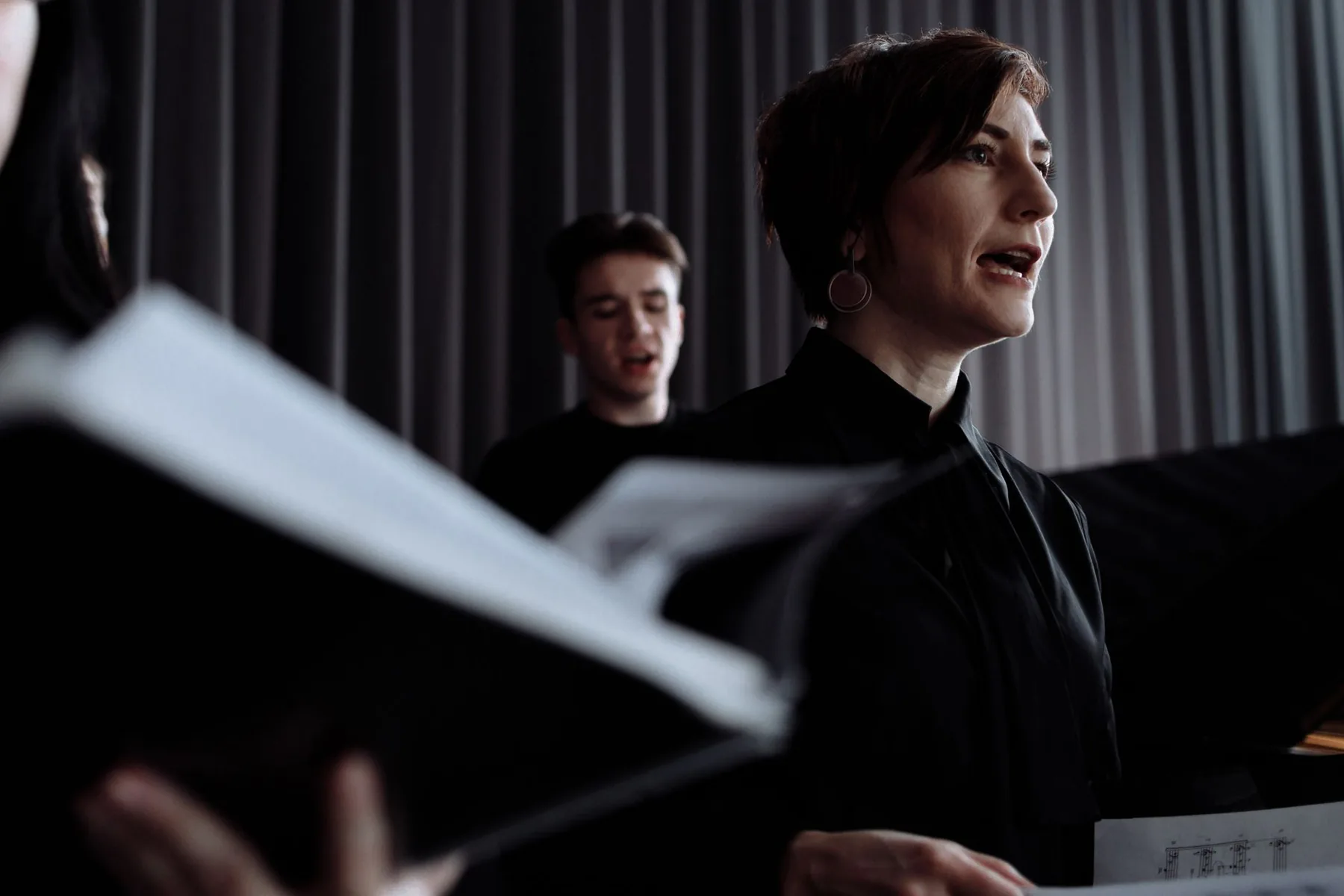
Start by finding recordings close to your forces. Videos such as “2018 Ensemble vocal Choeur Battant” or “202301 _ Concert Beaucaire” show staging and collective energy.
Note what works: section placement, articulation, dynamics and transitions. These observations feed your staging and interpretation ideas.
Organize a shared listening session with the conductor and sections. This aligns intentions and makes shared phrasing work easier.
- Linking listening to the scores under consideration helps verify the feasibility of nuances.
- Compare recordings of ensembles of the same size to anticipate real challenges.
- Record feedback: inspiring, demanding or suited to your acoustic.
“Live recordings, such as those by Choeur Battant, serve as concrete references for style and energy.”
Useful Keywords to Guide Your Song Choices
A targeted lexicon helps you quickly sort offers by style, forces and difficulty. Choose simple words that describe exactly what you are seeking: style, forces, level, period, language.
Practical examples: combine “SATB choir” + “piano reduction” + “French” to isolate editions suited to concert use. Cross “world” + “a cappella” + “20th century” to vary colors without losing coherence.
Before buying, check the preview and audio excerpts. They reveal duration, range and difficulty level better than the title alone.
- Create an internal taxonomy: tags by duration, difficulty and stage placement.
- Filter by available rehearsal time to avoid overly demanding pieces.
- Note winning combinations and share them among section leaders.
“Relevant keywords save time and strengthen program coherence.”
| Filter | Example use | Advantage |
|---|---|---|
| Style | Jazz / sacred / world | Find the desired color |
| Forces | SATB / SSA / TTBB | Adapt to your mixed voices |
| Duration & difficulty | <3 min / intermediate | Plan rehearsal time |
To learn more about useful musical terms for classification, consult this index of terms.
Conclusion
Let us close here with the essential choices for building a clear, progressive and inspiring season.
Strengths: the directory speeds up selection with price and delivery information (PDFs from EUR 2.00 and piano reductions delivered in 2 to 5 days).
The stylistic palette ranges from sacred music to world music, through local standards, and also covers the polychoral register.
On stage, care for the text, staging and phased work to turn a score into an experience.
Adapt the choice to the level and mixed voices available, program landmarks and discoveries, and always check audio previews before buying.
In this way, your choir will nourish its identity and artistic ambition throughout the season, in service of the music.