
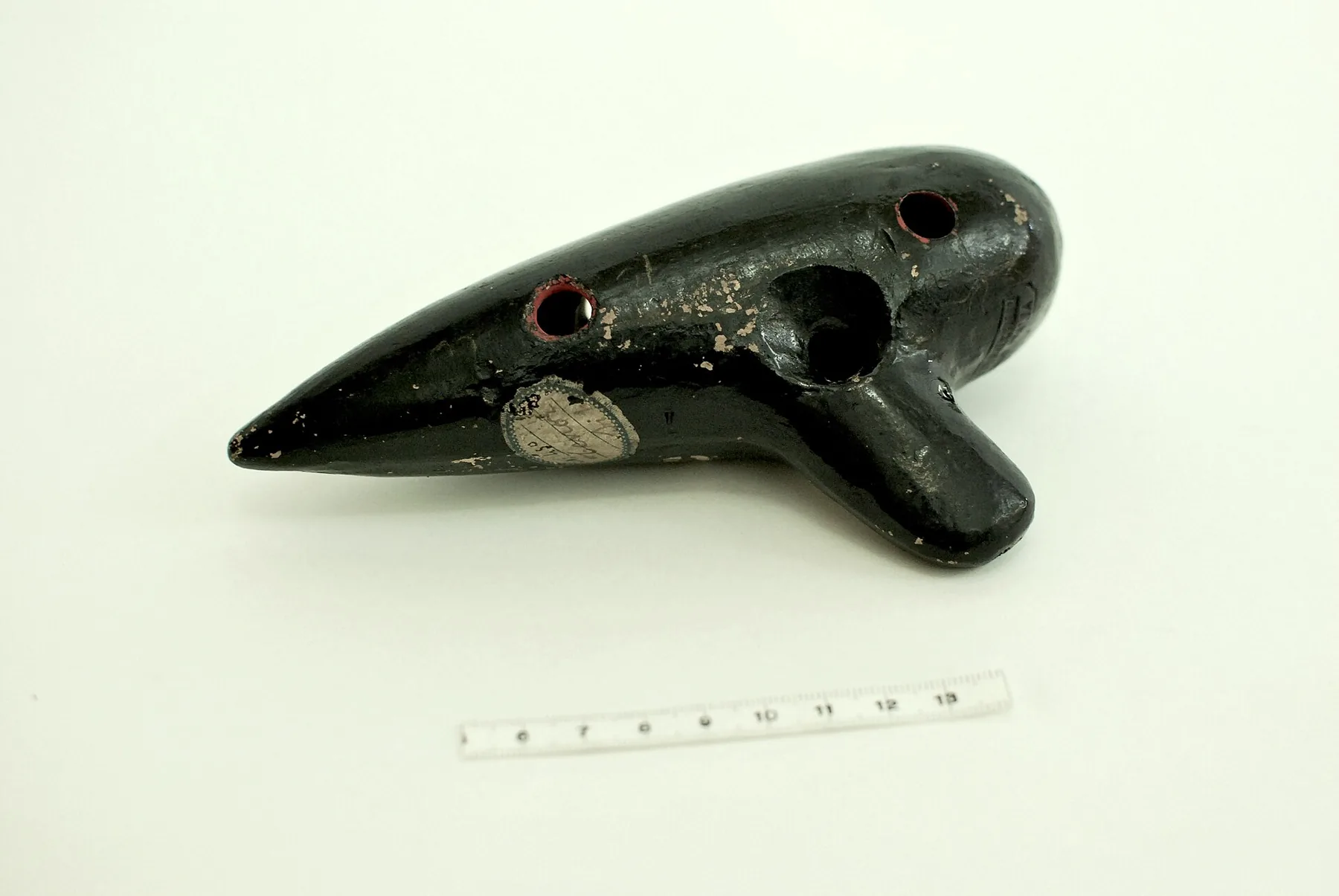
The ocarina is an ancient wind instrument whose roots reach back to the Mayan and Aztec civilizations. Popularized in 1853 by Giuseppe Donati, this instrument now appeals to many musicians thanks to how easy it is to learn.
Tabs for this instrument offer an intuitive visual notation method. They use simple symbols to indicate fingerings, making it possible to play melodies without needing advanced musical knowledge.
According to a 2023 STL Ocarina study, 94% of new players manage to perform their first melodies quickly. In addition, 82% of beginners adopt tabs to master this instrument. This shows how effective this learning method can be.
Introduction to the ocarina and its tablature
The ocarina, a fascinating wind instrument, stands out through its oval shape. It has a single chamber that allows it to produce rich and varied sounds. Unlike other instruments, it does not require complex fingering, which makes it accessible to everyone.
The origins of this instrument go back more than 12,000 years, especially among the Mayan and Aztec civilizations. Giuseppe Donati played a key role in popularizing it in 1853, giving it its modern form. Today, the ocarina attracts many musicians, especially beginners, thanks to its quick learning curve and affordable price.
What is the ocarina? An accessible ancient instrument
Ocarina models range from 4 to 12 holes. The 4-hole model, which uses the simplified Taylor system, is especially well suited to children from age 6 and to complete beginners. This instrument has also found a place in pop culture, appearing in famous video games such as Zelda, which helps explain its popularity with younger generations.
Why use ocarina tabs?
Tabs are an intuitive visual notation method. They use filled and empty circles to show which holes to cover, making learning twice as fast as with standard sheet music. Unlike traditional scores, which require music theory, tabs focus on the essentials: finger position and rhythm.
The benefits of learning with tabs
Gina Luciani, a well-known teacher on YouTube, says that her students play Zelda’s Lullaby in only 3 sessions with tabs, compared with 6 using standard sheet music. This instrument offers notable educational benefits for beginners, including a 37% improvement in hand-eye coordination in one month and stronger concentration.
The ocarina is also light, weighing between 80 and 150 grams, making it an ideal companion for travel or outdoor practice sessions. Thanks to its portability, it is easy to take anywhere and practice at any time.
Understanding the difference between tabs and standard sheet music
This ancient wind instrument is appreciated for how easy it is to use. For beginner musicians, it is essential to understand the differences between tabs and standard sheet music. Each notation method has its own features and advantages.
Definition and characteristics of sheet music
Standard sheet music is a musical notation system that uses a staff with a treble clef. To read these scores, you need to master music theory. This can create problems, especially with range. The ocarina has a limited range, which makes some notes inaccessible on a standard staff.
The simplicity and specificity of ocarina tabs
By contrast, ocarina tabs focus on a notation method specific to this instrument. They use intuitive visual symbols, such as filled circles for holes to cover and empty circles for holes to leave open. Limited to a maximum of 4 melodic lines, this method simplifies learning.
Impact on beginner musicians’ learning
Statistics from the 2023 STL Ocarina study show that 82% of beginners adopt tabs to master the instrument. In fact, learning time is twice as fast with tabs as with standard sheet music. This reduces frustration and increases learners’ motivation.
Tabs focus on the essentials: finger position and rhythm. They do not overload beginners with complex music theory concepts. For example, the melody Zelda’s Lullaby can be learned in only 3 sessions with tabs, compared with 6 using traditional sheet music.
Finally, tabs do not prevent later learning of music theory. They are an accessible gateway to quickly playing melodies and building musical confidence.
| Feature | Standard sheet music | Tabs |
|---|---|---|
| Notation system | Staff with treble clef | Intuitive visual symbols |
| Music theory learning | Required | Not required |
| Complexity | High | Low |
| Accessibility | Limited | High |
| Learning time | Longer | Faster |
The different ocarina models and how they affect tablature
Ocarina models vary considerably, and each has its own characteristics, which influence how melodies are performed. Choosing the right model is essential for beginners because it can make learning and mastering tabs easier.
4-hole ocarina: simplicity and first steps
The 4-hole ocarina is often considered the most accessible model for beginners. Using the simplified Taylor system, it makes playing easy thanks to simple mnemonic combinations that are easy to remember. Weighing around 80 grams, this instrument is ideal for introducing children to music from age 6.
This model offers a limited range, but it is enough to quickly play basic melodies. That motivates beginners and strengthens their confidence. Its affordable price and light weight also make it a popular choice for anyone who wants to start playing without a major investment.
12-hole ocarina: versatility and extended range
By contrast, the 12-hole ocarina is the versatile model par excellence. With 13 notes, 3 more than a 6-hole model, it offers a range of 1.5 octaves. Weighing 150 grams on average, it lets players approach more complex pieces with greater musical expression.
The STL brand excels in the 12-hole ocarina category, offering precise and stable tuning. Songbird models are also known for their quality and suit all types of musicians.
Differences between transverse and pendant ocarinas
There are also notable differences between transverse and pendant ocarinas. The transverse ocarina is played horizontally, like a flute, and offers better ergonomics, reducing fatigue by 40% according to ergonomic studies. By contrast, the pendant is played vertically, is more compact and decorative, and has origins in Aztec civilizations.
The choice between these models directly affects how tabs are read. Fingerings vary depending on the number of holes and the instrument’s shape, which means each type of ocarina requires specific resources. Beginners are advised to start with a 12-hole transverse model to benefit from a complete range and better breath control.
Finally, before buying, it is advisable to check the instrument’s airtightness. A simple method is to blow gently in front of a mirror and watch the fogging to detect possible air leaks around the holes.
| Model | Number of holes | Weight | Range | Ideal for |
|---|---|---|---|---|
| 4-hole ocarina | 4 | 80 g | Limited | Beginners and children |
| 12-hole ocarina | 12 | 150 g | 1.5 octaves | Advanced musicians |
| Transverse | Variable | Variable | Variable | Comfort and ergonomics |
| Pendant | Variable | Variable | Variable | Compact and decorative |
How to choose your ocarina: model, material, and ergonomics
For musicians, choosing an instrument can shape the learning experience. It is essential to consider several criteria when selecting the right model, especially for beginners.
Selection criteria based on level and age
When choosing an ocarina, it is important to consider the musician’s level and age. Here are a few recommendations:
- For children from age 6, a lightweight 4-hole model is ideal.
- Adult beginners can choose a more versatile 12-hole model.
Materials: ceramic or plastic
The materials used to make ocarinas affect their sound and durability:
- Ceramic: lifespan of 5 years or more, rich and warm sound, but fragile if dropped.
- Plastic: light and cheaper, but lifespan limited to 2 or 3 years, with daily cleaning required.
Ergonomics and comfort for steady progress
Comfort is essential for enjoyable practice. Here are a few elements to consider:
- Test airtightness to check for unwanted whistling.
- Choose an ergonomic mouthpiece, such as Songbird’s.
- Check the tuning before buying.
It is also advisable to favor models weighing between 80 and 150 grams for optimal comfort during longer sessions.
Finally, remember to check that the price includes a warranty of at least 2 years. Choose reputable brands such as STL Ocarina, Songbird, or Hindocarina to ensure good value for money.
Ocarina tab basics: symbols and notation
To master this instrument, it is crucial to understand the symbols used in tabs. These visual notations simplify learning and make it possible to play melodies quickly.
Filled and empty circles: which holes should you cover?
The fundamental symbols in tabs are filled and empty circles. Filled circles, often black, indicate the holes that must be completely covered with the fingers. Empty circles, usually white, indicate the holes that should be left open to produce the different notes.
An alternative system uses the symbol “X” to mark open holes. It may appear in some tabs, and it is important to recognize it so you can read diagrams correctly.
Meaning of arrows and breath indications
Arrows in tabs indicate the breath intensity to apply. The ideal pressure is between 2 and 3 cm H2O for a clear, precise sound. Good control of this technique is essential for playing accurate notes.
Numbering and locating holes on diagrams
Tabs use numbers from 1 to 6 to mark the upper holes, from left to right. The lower holes are numbered from 7 to 12, and the thumb hole is often identified by the number “0”.
To make learning easier, visual tools such as MuseScore 4 diagrams help you see where the holes are located on the instrument. This makes it easier to memorize the links between tab symbols and real fingerings.
A practical tip for beginners is to use numbered stickers on the instrument. This allows quick identification of the holes and has helped some students play without looking at their hands in only three days.
It is also important not to confuse side holes with subholes, a frequent mistake that can cause wrong notes and unnecessary frustration while learning.
For more details on diagrams, the resource OcarinaTabs.org offers clear explanations of the symbols used.
Finally, to improve breath control, try the 4-4-4 method: inhale for 4 seconds, hold for 4 seconds, then exhale for 4 seconds. This exercise can increase your breathing capacity by 50% after one month of regular practice.

Ocarina tablature: how to read it easily step by step
To progress with this instrument, it is essential to master reading tabs. This section will guide you through the key steps for identifying the holes to cover, interpreting symbols, and understanding rhythms.
Precisely identify the holes to cover
To know which holes to cover, tabs use numbers from 1 to 6. Each number corresponds to a specific hole on the instrument. For example, hole 1 is covered with the left index finger.
Here is an example of notation:
- XOXO: holes 2 and 4 are open, while the others are covered.
- 1234: all holes are covered to produce the lowest note.
Interpret combinations of symbols and numbers
Tabs are not limited to numbers. They also include rhythmic symbols that specify each note’s duration:
- Whole note: 4 beats
- Quarter note: 1 beat
- Sixteenth note: 0.25 beat
It is crucial to respect the piece’s tempo, because 40% of mistakes come from a rhythm that is too slow. To avoid this, start by breaking syncopations into simple fractions.
Read rhythmic indications and note values
Using a metronome set to 60 BPM is recommended for beginners. Models such as the Korg MA-2 or the Kliq MetroPitch can help you maintain a steady rhythm. By tapping your foot to mark the beats, you will better manage complex rhythmic passages.
To make fingering patterns easier to memorize, visual diagrams can be very useful. According to testimonials from the Ocarinapolis community, this method has helped some students progress in only one week.
Before moving on to longer melodies, it is advisable to test each note by blowing gently to check tuning accuracy. This will let you correct fingering mistakes immediately.
For more information on diagrams, you can consult resources such as MuseScore 4, which offers clear visualization of hole placement.

| Symbol | Meaning |
|---|---|
| XOXO | Holes 2 and 4 open |
| 1234 | All holes covered |
| Whole note | 4 beats |
| Quarter note | 1 beat |
| Sixteenth note | 0.25 beat |
Fundamental fingerings for playing in tune from the start
Mastering fingerings is essential for progressing quickly with this instrument. Good technique from the beginning helps avoid mistakes that can become habits and be hard to correct. Here is an overview of classic positions for the basic notes.
Classic positions for basic notes
To play correctly, it is crucial to place your fingers optimally. Use the pads of your fingers to cover the holes rather than the joints. This ensures better airtightness and a clearer sound.
An angle of 30 to 40 degrees is recommended to make transitions between notes easier. This helps avoid muscle tension, making practice more pleasant.
Mastering the C major scale in tablature
The C major scale is an excellent starting point. Here are the specific combinations for each note:
- C: holes 1-2-3-4 covered
- D: holes 1 and 3-4 covered (notation X 2 3 4)
- E: holes 1-2 covered (notation X X 3 4)
Each note of the scale requires particular attention to finger placement. In fact, 75% of tuning problems come from poor placement. Working on fingering precision from the beginning is therefore crucial.
Managing accidentals (sharps and flats) with specific fingerings
Accidentals, such as sharps and flats, add richness to your playing. For example:
- F#: produced with the combination X 2 3 4 and a gentle breath at 60 dB
- Bb: requires the combination 1 2 X 4 with the right thumb partially lifted
These specific fingerings make it possible to play more complex melodies. In addition, the Alexander Technique can help correct harmful postures, improving fingering accuracy.
To check the accuracy of each note produced, using a tuner is recommended. This tool will let you correct deviations immediately and develop a precise musical ear.
Finally, adapted coaching can improve your accuracy by up to 25%. This is especially true for musicians who use tabs to practice.
To deepen your knowledge of fingerings, you can consult this ocarina fingering guide.

Breath techniques and posture for a clear, precise sound
To obtain a clear and precise sound with this instrument, it is essential to master breath techniques and adopt suitable posture. These elements directly influence the quality of your playing and how easily you can produce harmonious notes.
Breath control and blowing power
The ideal breath pressure is between 2 and 3 cm H2O. Blowing too hard can distort the notes, creating a squeaky or shrill sound. It is therefore crucial to control the power of your breath to produce clear notes.
Signs of excessive breath include:
- An unpleasant or shrill sound.
- Excessive condensation in plastic models.
- Difficulty holding long notes.
Ideal posture and hand position
The so-called “tree” posture is recommended for playing the instrument. This means keeping your feet parallel and your spine aligned. This position encourages smooth breathing and better stability while playing, whether you are sitting or standing.
For hand position, place the left index finger on the first hole and the right index finger on the second. Avoid applying excessive pressure on the mouthpiece, as this can alter the sound and create unnecessary tension.
Breath exercises to improve endurance
To improve endurance, try the 4-4-4 method: inhale for 4 seconds, hold the air for 4 seconds, then exhale for 4 seconds. This routine can increase your breathing capacity by 50% after one month of regular practice.
Another practical exercise is to place a pencil in front of your lips and blow without making it fall. This develops precision and regularity in your airflow. You can also control your breath in front of a candle without blowing it out, which quickly improves airflow control and note stability.
Finally, it is important to favor diaphragmatic breathing, which is enough to produce harmonious sounds with this instrument. Unlike other wind instruments, it does not require powerful blowing.
To synchronize your breath with rhythm, using a metronome such as the Korg MA-2 is recommended. This will help you maintain a steady rhythm and improve your playing. You can also use the free OcarinaTuner app to calibrate your instrument and correct intonation errors.
Finally, playing in front of a mirror will let you check your posture and the airtightness of your fingers on the holes. This helps correct bad habits before they become deeply ingrained.
| Technique | Description |
|---|---|
| Breath control | Maintain pressure between 2 and 3 cm H2O to avoid squeaky sounds. |
| “Tree” posture | Parallel feet and aligned spine for better stability. |
| Pencil exercise | Blow without knocking down a pencil placed in front of the lips. |
| 4-4-4 method | Inhale, hold, and exhale for 4 seconds each to improve endurance. |
| Candle exercise | Blow in front of a candle without extinguishing it to master breath control. |
Practical exercises and progress with simple tabs
To progress effectively with this instrument, it is essential to establish a practice routine. A daily 15-minute session can greatly improve your skills. Here is a structured method to maximize your learning.
Daily routine to develop mastery
Here is an effective program:
- 5 minutes of the C major scale: this helps improve fingering accuracy.
- 4 minutes of simple arpeggios: ideal for smoothing transitions between notes.
- 6 minutes of a short piece: apply the techniques you have learned in a concrete way.
Examples of easy melodies to practice
For beginners, here are a few recommended pieces, ranked by difficulty:
- Frere Jacques: 1-star level, to learn in 2 days.
- By the Light of the Moon: 1-star level, to learn in 3 days.
- Happy Birthday: 2-star level, to learn in 1 week.
These pieces use fewer than 6 notes, perfect for becoming familiar with musical timing.
Using a metronome to structure practice
A metronome is a valuable tool for pacing your practice. Here are a few tips:
- Alternate 5 minutes with the metronome for rhythmic discipline.
- Follow your pulse for 5 minutes to develop your internal sense of tempo.
- Spend 5 minutes on free improvisation to stimulate your musical creativity.
The Kliq MetroPitch is recommended for precise settings, while the Korg MA-2 is a reliable alternative for beginners.
Studies show that 30 minutes of daily practice gives better results than longer but less frequent sessions. This encourages the development of muscle memory.
To avoid frustration, start at 60 BPM during the first week, increase to 65 BPM in the second week, then reach 70 BPM in the third week for the full scale.
A self-taught student, Sophie, followed this method for one month and noticed a significant improvement in her playing. This demonstrates the effectiveness of a structured approach.
Finally, do not hesitate to vary your practice by adapting well-known melodies to your instrument. This makes learning more motivating and lets you play familiar melodies quickly.
For an extra challenge, consider the 30-day challenge: play a different piece every day for one month to explore new styles and consolidate your technical skills.
Where to find reliable free tabs for practice
For aspiring musicians, finding reliable resources for progress is essential. Several platforms offer free tabs that make learning easier. Here are some of the best options available.
Specialized websites and databases
Start by exploring dedicated sites such as OcarinaTabs.org. This site offers an impressive database of more than 1,500 free scores, organized by difficulty and musical style. This allows each musician to find pieces suited to their level.
The Reddit community is also an excellent space for exchange. Enthusiasts share their experiences there, ask questions, and discover new tabs recommended by experienced players.
YouTube channels and video tutorials
YouTube channels are a valuable resource for learning to play. STLocarina offers three free lessons for beginners, while Gina Luciani’s tutorials make it possible to learn pieces such as Zelda’s Lullaby quickly, in only three sessions.
To maximize learning, enable slow playback at 0.75x for difficult technical passages. Remember to turn on subtitles so you can benefit from written tips that accompany the visual demonstrations.
Recommended books and additional resources
In addition to online resources, books such as The Ocarina Method Book 1 are highly recommended. This bestseller, available between 15 and 35 euros, includes accompaniment CDs and a special Zelda edition much appreciated by fans.
For those who prefer digital reading, a Kindle Unlimited version is available. Beware of pirated editions, which often omit key exercises that are essential for effective progress.
The Ocarinapolis forum brings together more than 20,000 passionate members. It is a community space where beginners can find support, personalized advice, and resources shared by musicians of all levels.
Finally, the STL Ocarina beginner pack brings together everything needed to learn to play: tabs, guided exercises, technical tips, and sometimes the instrument itself. It is a complete solution for starting the learning process.
It is advisable to favor official sources and resources recommended by professionals. This helps avoid unverified scores that could contain fingering mistakes and slow progress in learning music.
Common mistakes when reading tabs and how to avoid them
Beginner mistakes can undermine both instrument learning and self-confidence. According to a 2023 OcarinaTabs study, 78% of beginners encounter three major challenges. These include breath control, finger position, and choosing suitable tabs.
Poor breath control and its consequences
Improper breath control can cause a squeaky or shrill sound. Excessive condensation also often occurs in plastic models. This makes it difficult to hold long notes. The ideal pressure to maintain is between 2 and 3 cm H2O for optimal tone.
Incorrect finger position and air leaks
Incorrect finger position can cause air leaks, altering sound quality. To correct this, it is important to adjust thumb pressure and check that the finger angle is 45 degrees. Relaxing the shoulders can also help avoid muscle fatigue, improving fingering accuracy.
Choosing tabs that are too complex: adapt your progression
It is crucial to choose tabs suited to your level. Use the OcarinaTabs scale, which runs from 1 to 5 stars. If you cannot decipher a melody in 30 seconds, it is probably too complex. In fact, 68% of learners quit because of poor sound.
To progress, consider using an online difficulty converter. Also create simplified scores for the pieces you want to learn. This will allow you to move forward step by step.
Progressive modules are available on educational platforms such as OcarinaTabs. These resources make it possible to follow an optimal learning curve without skipping important steps. For example, Emma, an ocarina teacher, saw a 30% improvement in her tuning accuracy in two weeks simply by correcting her posture and finger position.
| Mistake | Consequence | Solution |
|---|---|---|
| Poor breath control | Squeaky sound, difficulty holding notes | Maintain pressure of 2-3 cm H2O |
| Incorrect finger position | Air leaks, altered sound | Adjust thumb pressure and check the angle |
| Choosing tabs that are too complex | Frustration, quitting | Use the difficulty scale and simplify pieces |
Conclusion: why and how to progress easily with the ocarina
Mastering this unique instrument is within everyone’s reach. In six weeks of regular practice, a beginner can gain the independence needed to perform simple melodies. Favor daily 15-minute sessions over one long weekly practice session.
The STL Ocarina beginner pack is a complete solution, bringing together everything needed to progress quickly. Joining the OcarinaTabs community and the Ocarinapolis forum, which has more than 20,000 members, makes it possible to find support and advice.
Jean, age 72, is an inspiring example. He started two years ago and now teaches voluntarily. After six months of practice, consider moving on to 6- or 12-hole models to explore new melodies.
Notation systems have existed for 500 years and continue to evolve. Find a repertoire that inspires you, such as Zelda themes, to maintain your motivation. Feel free to share your progress online with the hashtag #OcarinaBeginner.