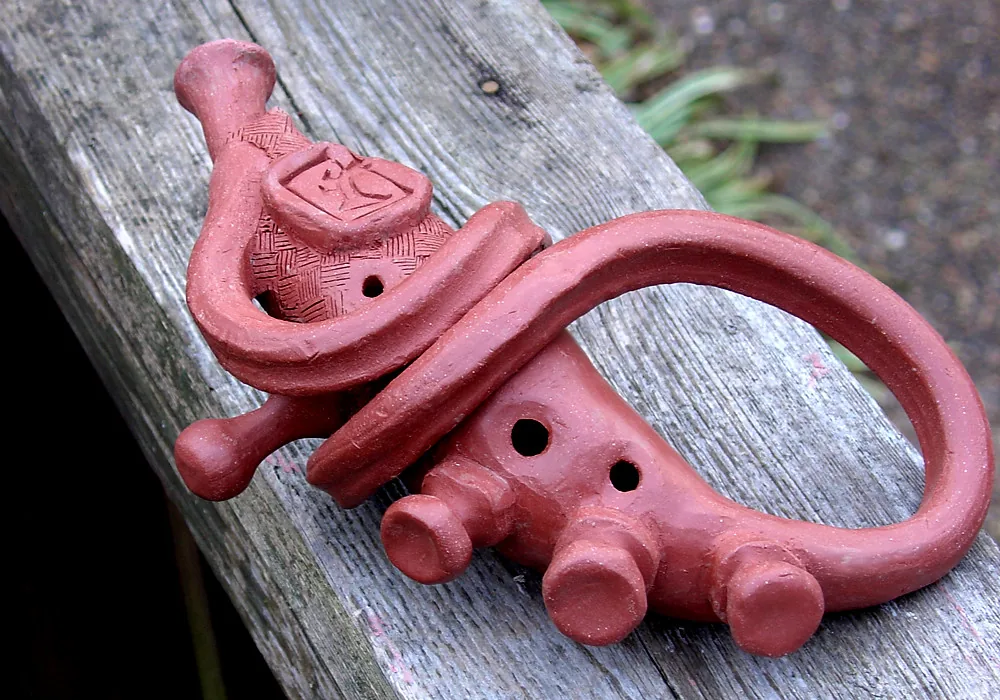
The ocarina is a fascinating wind instrument. Its ovoid shape and its name, derived from the Bolognese dialect meaning “little goose,” give it a unique identity. This instrument has captivated musicians and listeners around the world.
The earliest traces of this instrument date back around 12,000 years, making it one of the oldest still played today. The ocarina appears in many cultures, including pre-Columbian, Asian, African and European traditions. This reflects a rich, cross-cultural history.
In this article, we will explore the ancient origins, European evolution and technical characteristics of the ocarina. We will also look at its use in music and culture, as well as its place in the contemporary world.
What is the origin of the ocarina? The ancient roots of this fascinating instrument
The origins of the ocarina are fascinating and go back thousands of years. One of the oldest ocarinas discovered in Europe comes from the Rudnik region in Kosovo. This wind instrument, which resembles a flute, is about 8,000 years old. It is considered the oldest prehistoric musical instrument recorded in that region.
Made of terracotta, this object shows the ability of Neolithic people to create melodious sounds from simple materials. This craftsmanship reveals the importance of music in the daily lives of our ancestors.
The first archaeological traces
The discovery of the Runik ocarina marked a turning point in the understanding of ancient musical instruments. Measuring about 8 cm and equipped with four holes, this instrument is an emblematic example of human creativity.
The ocarina in the pre-Columbian cultures of South America and Mesoamerica
In South America, pre-Columbian cultures, such as the Chibchas in Colombia and the Aztecs, also developed similar instruments. The Aztecs called their ocarina huilacapiztli in Nahuatl. These objects, often made of terracotta, took many zoomorphic forms, representing animals such as llamas, birds or even felines.
Peruvian ocarinas, for example, are characterized by their ovoid shape and generally have eight holes. These instruments were not only used to play music, but also in sacred rituals, illustrating their cultural importance.
Asian and African influences
In Asia, the Chinese xun, which is 7,000 years old, is often considered an ancestor of the ocarina. It differs in playing technique: the xun is blown across the outer edge, while the ocarina uses an internal duct to produce sound.
Another example is the Hui niwawu, a traditional instrument of the Hui ethnic group from Ningxia, China. This ox-head-shaped ocarina was listed as intangible cultural heritage in 2005, illustrating the diversity of forms this instrument can take around the world.
There are several theories about the origin of the ocarina. Some researchers favor a pre-Hispanic origin in South America, while others point to Asian or European origins. This shows the richness and complexity of the instrument’s history.
In conclusion, the universality of the ocarina is fascinating. Present on several continents for millennia, this instrument is a remarkable example of the way human cultures independently developed similar instruments.
The evolution of the ocarina in Europe: from the medieval gemshorn to the modern instrument
Over the centuries, the ocarina underwent a fascinating evolution in Europe. Its history was shaped by key moments that contributed to its current popularity. This transformation began in the 16th century with the rediscovery of the instrument by the general public.
Rediscovery and spread in the 16th century
In 1527, a troupe of Aztec musician-dancers captivated Emperor Charles V. They presented the ocarina, which sparked strong interest. This event triggered a wave of fascination for the instrument across Europe.
The troupe’s demonstrations introduced the ocarina to a wider audience. European musicians began taking an interest in this instrument, paving the way for its integration into European music.
Giuseppe Donati and the transformation of the ocarina in the 19th century
The 19th century marked a decisive turning point for the ocarina. Giuseppe Donati, a musician and baker from Budrio, transformed the instrument in 1853. He created the transverse 10-hole model, allowing players to perform a full chromatic range of 11 notes.
Donati chose the name “ocarina,” meaning “little goose” in the Bolognese dialect, because of the instrument’s shape. In 1864, he founded the Budrio Ocarina Group, the first professional ensemble dedicated to this instrument. This helped establish the ocarina as a true musical instrument.
20th-century innovations
The 20th century brought major innovations. In 1928, Japanese sculptor and musicologist Takashi Aketagawa created the 12-hole ocarina, which became today’s standard model. This model extended the range to 2.5 octaves, opening up new musical possibilities.
After 1950, Japan played a key role in the ocarina’s revival. Musicians such as Nomura Sojiro contributed to its popularity. In addition, the invention of multi-chamber models, such as double and triple ocarinas, made new polyphonic possibilities available, enriching the musical experience.
In conclusion, the evolution of the ocarina is remarkable. This instrument, which began as a simple terracotta toy, became a sophisticated instrument appreciated by musicians around the world.
Technical characteristics and diversity of ocarina models
Ocarinas are fascinating instruments distinguished by their diversity and technical characteristics. This wind instrument, classified among ducted globular flutes, offers a variety of models that appeal to musicians all over the world.
Materials and manufacturing techniques: from terracotta to plastic
The materials used to make an ocarina directly influence its timbre and sound quality. Here is an overview of the most common materials:
- Terracotta: produces a warm, resonant sound.
- Porcelain: offers a clearer sound.
- Wood: generates a soft, earthy sound.
- Plastic: affordable and durable, but tonally less complex.
- Metal: produces a bright, powerful sound.
The craft manufacturing process, especially for terracotta ocarinas, plays a crucial role in the final acoustic quality. Firing the clay preserves ancestral techniques while integrating modern innovations.
The different types of ocarinas: transverse, pendant, double and triple
Ocarinas come in several types depending on their shape and number of holes. Here are a few examples:
- English ocarina: 6 holes, producing 10 notes.
- Peruvian ocarina: 8 holes, producing 11 notes.
- Linear ocarina: 10 holes.
- 12-hole ocarina: 13 notes, offering a full chromatic scale.
- Double ocarina: 17 notes.
- Triple ocarina: 21 notes.
- Quadruple ocarina: 24 notes.
Pendants, which are portable models, also exist in two types: the English pendant (4 to 6 holes) and the Peruvian pendant (8 holes). Each model is designed to match the keys of C major, F major and G major.
Acoustic operation: Helmholtz resonator and unique timbre
As a Helmholtz resonator, the ocarina produces a melancholy, nostalgic sound. This acoustic phenomenon explains why this wind instrument is so highly appreciated. By covering or uncovering the various holes with the fingers, the musician changes the resonant frequency of the internal cavity, allowing them to play a complete scale.
Keyed ocarinas, developed since the late 19th century, as well as “inline” or “fusion” models, combine the advantages of pendants and transverse ocarinas, offering a compact grip with an extended range.
In conclusion, the technical diversity of the ocarina is impressive. It exists in several sizes, corresponding to varied registers such as soprano, alto, tenor and bass. This instrument can therefore adapt to every style of music and every level of practice.
| Type of ocarina | Number of holes | Notes produced |
|---|---|---|
| English ocarina | 6 | 10 |
| Peruvian ocarina | 8 | 11 |
| Linear ocarina | 10 | 10 |
| 12-hole ocarina | 12 | 13 |
| Double ocarina | 17 | 17 |
| Triple ocarina | 21 | 21 |
| Quadruple ocarina | 24 | 24 |
The use and place of the ocarina in music and culture
For centuries, the ocarina has held an essential place in various musical traditions around the world. Thanks to its unique sound, this instrument accompanies many rituals and festivities, particularly in the Andes. In countries such as Peru, Bolivia and Ecuador, the ocarina is often played during celebrations such as the Cuzco festival, keeping ancestral traditions alive.
Role in traditional and regional music
In traditional music, the ocarina stands out for its ability to evoke deep emotions. This musical instrument, with its melodious notes, is often used to accompany folk songs and dances. By playing the ocarina, musicians pass on stories and legends, connecting past and present generations.
Presence in classical and contemporary music
From the late 19th century onward, the ocarina appeared in classical music. Composers such as Leoš Janáček included it in their work, notably in his cycle Říkadla in 1927. Likewise, György Ligeti used four ocarinas in the second movement of his Violin Concerto between 1990 and 1993. This recognition in the classical world demonstrates the instrument’s versatility.
The ocarina in popular culture: cinema, video games and media
The ocarina has also found its place in popular culture. In the film The Good, the Bad and the Ugly (1966), Ennio Morricone used an arghilofono, a low-pitched version of the ocarina, to create a memorable atmosphere. In addition, the ocarina became iconic in the video game The Legend of Zelda: Ocarina of Time (1998). In this game, players learn to play melodies on the ocarina to progress, which led to a 300% increase in instrument sales in 1999.
This success was also amplified by appearances in other works, such as My Neighbor Totoro, Captain Harlock, Princess Sarah, and even games such as Professor Layton and the Last Specter. The title Song of Ocarina was a major success in France in the 1990s, helping introduce this instrument to the general public.
In short, the ocarina is considered both a nostalgic and modern instrument. It fits harmoniously into classical compositions while also finding its place in film soundtracks and contemporary video games. Thanks to its melancholy timbre, the ocarina transcends genres and eras, affirming its unique place in global musical culture.

The ocarina today: an accessible instrument undergoing a strong revival
Today, the ocarina attracts a wide range of enthusiasts, from children to adults. Thanks to its ease of use and affordable price, this instrument has become a favored choice for beginners. Prices range from 20 to 150 euros, depending on the materials and models. Sales have in fact increased by 15% each year since 2015, reflecting growing enthusiasm for this instrument.
Renowned brands such as Focalink and STL Ocarina offer models suited to all levels. Whether for a child discovering music or an experienced musician, several options are available. Plastic ocarinas are perfect for learning, while ceramic or wooden versions meet the expectations of more demanding musicians.
Learning resources and technological innovations
To support this interest, many learning resources are now available. Online platforms such as OcarinaForest.com offer detailed lessons. In addition, video tutorials by masters such as Nomura Sojiro make it easier to learn the first notes and master fingerings.
Technological innovations also play a key role in the revival of this musical instrument. Modern models, such as MIDI ocarinas and connected versions, make it possible to integrate the instrument into electronic compositions and digital performances. These advances open new perspectives for contemporary musicians.
The ocarina and the contemporary music scene in France and around the world
In Italy, collaborative projects, such as ocarina orchestras, strengthen the popularity of this instrument. These ensembles carry on the legacy of Giuseppe Donati while exploring new repertoires beyond traditional music. In France, although development is slower, enthusiasts create websites and learning methods to share their love of the ocarina.
It is important to note that several types of ocarinas exist to suit every playing style and every budget. This makes the instrument accessible to everyone, from children discovering music to professional musicians seeking new sounds. In conclusion, the 21st century marks a revival for the ocarina, supported by a growing community of enthusiasts and a stronger presence in popular culture.

Conclusion
The ocarina, an instrument with ancient roots, continues to evolve. This fascinating journey spans more than 12,000 years, connecting varied cultures from South America to Asia and Europe. Each era has seen unique models emerge, such as the Chinese quadruple ocarina, invented between 2007 and 2009, which enriches the instrument’s diversity.
In the 21st century, the ocarina is recognized in countries such as Italy, Japan and the United States. Its ovoid shape and Helmholtz resonator operation give it a melancholy timbre appreciated in many musical styles. Communities of passionate musicians continually explore its possibilities.
We invite you to discover the playing of this accessible instrument, which offers a simple and expressive musical experience, whether you are a beginner or an experienced musician. The ocarina still has a bright future ahead, promising unmatched sonic richness.