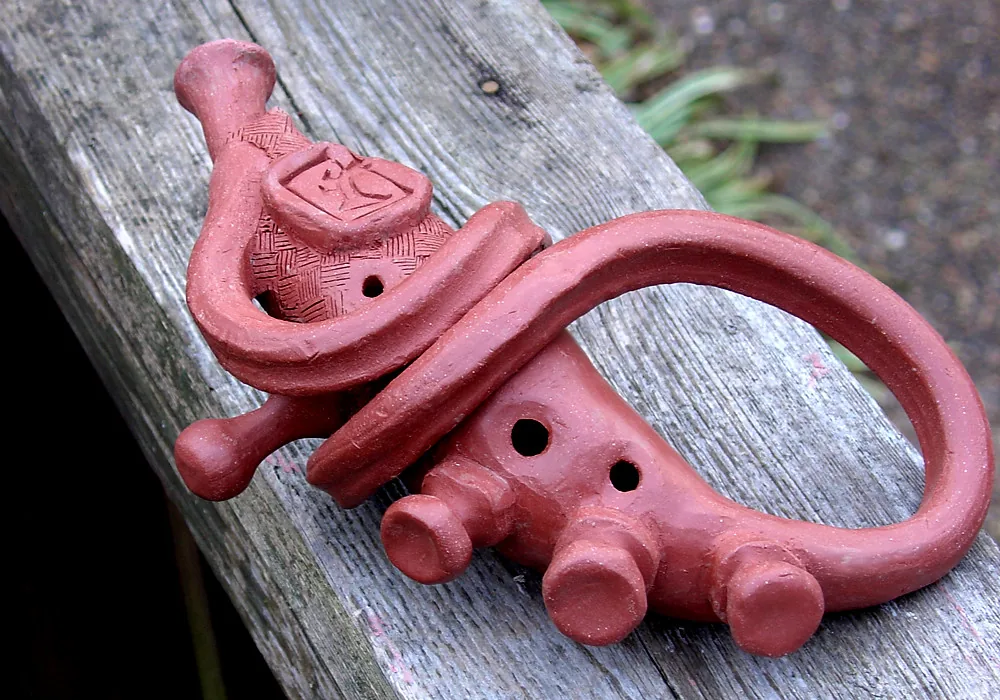
The ocarina is a fascinating wind instrument, perfect for anyone who wants to get started with music. Accessible even with no previous experience, this instrument offers a fast learning curve. After a few weeks of regular practice, you will be able to play your first melodies.
This guide is designed to support you step by step, from choosing your first ocarina to mastering advanced techniques. We will cover the history of this instrument, the benefits of learning it, and the different models available.
Ceramic and plastic ocarinas are ideal for beginners. They are not only affordable, but also durable. Whether you choose a lightweight plastic model or a ceramic model with a warm sound, you will easily find the one that suits you.
Follow this guide to make steady progress, whether you choose to teach yourself or take structured lessons. Thanks to online resources, such as free sheet music and enthusiast communities, your musical adventure is only just beginning.
What is an ocarina and why learn it?
A true musical treasure, the ocarina has fascinating origins. This wind instrument took on its modern form in 1853 thanks to the Italian craftsman Giuseppe Donati. Its roots, however, are much older: related instruments already existed in several pre-Columbian civilizations, especially among the Maya and the Aztecs, where they accompanied certain rituals.
The oval shape of the ocarina, combined with its precisely placed holes, creates a unique resonance. This allows the instrument to produce soft, melodic sounds that have captivated listeners throughout time.
Origins and history of the ocarina
Giuseppe Donati brought this ancient wind instrument back to life by giving it a modern form. Before that, the ocarina was already a cultural object, used by various civilizations to express emotions and beliefs.
Materials: ceramic and plastic
Two materials dominate ocarina making: ceramic and plastic. Ceramic offers a warm, rich tone, ideal for musicians seeking a more expressive sound. Plastic, by contrast, stands out for its light weight and durability, making it a popular choice for beginners.
Unique sounds and cultural reach
The sounds of the ocarina transcend cultural boundaries. From the Andes to Japan, this instrument brings people together through music. Today, it is also present in popular culture, particularly through video games, attracting a new generation of musicians.
In short, the ocarina is an accessible instrument capable of producing harmonious melodies with moderate breath. Whether you are a beginner or an experienced musician, this ocarina offers a rewarding experience.
The benefits of playing the ocarina for beginners
Discovering this wind instrument offers a wide range of benefits. First, its accessibility is remarkable. No prior knowledge of music theory is required, making it one of the easiest instruments to approach.
Accessibility and ease of learning
Beginners can quickly get started with this instrument. The learning curve is fast, and progress can be seen within the first few weeks. With a little practice, you will be able to play your first melodies in no time.
Developing coordination and concentration
Playing the ocarina improves coordination between the fingers, listening, and breathing. This skill develops quickly through learning sequences of notes. In addition, concentration improves, which is beneficial in other areas of life.
Why this instrument appeals to all ages
Its compact, lightweight format makes it ideal for everyone, from children to adults. Unlike other wind instruments, it only requires moderate breath. Jean, aged 72, began playing and proves that it is never too late to get started with music.
In fact, 68% of beginners correct their intonation mistakes in just three weeks with a digital tuner. This rapid progress maintains motivation and encourages regular, enjoyable practice.
How do you choose the right ocarina to start with?
Choosing the right ocarina is essential for an enjoyable learning experience. With a variety of models and keys available, it is important to understand the options open to you.
Types of ocarinas: transverse or pendant
There are mainly two types of ocarinas:
- Transverse: it is held horizontally, like a flute, with 10 to 12 holes. This model allows precise control of the notes, making it ideal for musicians who want to progress quickly.
- Pendant: compact and worn around the neck, it is limited to 4 or 6 holes. Perfect for children, it is light and easy to handle.
Keys: soprano, alto, or bass
An ocarina’s key affects its sound and how it feels to play:
- Soprano: it produces a high-pitched sound suited to lively melodies, and can be suitable for beginners who enjoy bright registers.
- Alto: it offers a balance between low and high registers, often comfortable for starting out and progressing.
- Bass: it delivers a rich, deep sound, suitable for musicians looking for a lower register.
Choosing materials: advantages and disadvantages
The materials used for ocarinas play a crucial role in their sound:
- Ceramic: it offers a warm, expressive sound, with prices ranging from €30 to €60. However, it is more fragile and requires careful maintenance.
- Plastic: shock-resistant and affordable, it costs between €10 and €40. It is lightweight, but may be prone to condensation.
Single-chamber versus multichamber models
Multichamber ocarinas allow you to play more notes, but they are generally more expensive and bulkier. It is advisable to start with a simple 12-hole model before moving on to a multichamber model.
Recommendations for avoiding pitfalls
Watch out for common pitfalls when buying:
- Avoid Peruvian ocarinas sold as decorative souvenirs, which are often poorly tuned and of limited musical quality.
- Choose recognized brands such as STL or Hindocarina to ensure good tuning quality.
- Check that an instruction manual is included and make sure the model matches the standard fingering system.

By following these tips, you will be better prepared to choose an ocarina that meets your needs and your level of experience. For more information on the different types of ocarinas, see this article dedicated to choosing a first ocarina.
The essential basics for learning to play the ocarina
Mastering the fundamentals of this wind instrument is crucial for making quick progress. This section will help you understand how to hold your ocarina, control your breath, and produce your first clear notes.
How to hold your ocarina correctly
For a good grip, place your left index finger on the first hole and your right middle finger on the second. Keep your hands relaxed to avoid tension. This allows for smoother playing.
Adopt a standing posture, with your back straight and your feet slightly apart. This position optimizes breath control and ensures good stability while you play.
Breath control and posture
Use diaphragmatic breathing to produce stable notes. Breathe in deeply through your nose, expanding your belly, then exhale slowly into the instrument’s mouthpiece. This helps produce a clear, powerful sound.
Avoid pressing the mouthpiece too firmly with your lips. Excessive pressure can create unwanted sounds, such as whistling. Practice the candle exercise: try to make the flame flicker without blowing it out in order to master your breath.
Producing your first clear notes
To produce your first notes, start by blowing gently into the instrument. Alternate between open and closed holes. This will allow you to play simple melodies, such as “Happy Birthday,” in just a few minutes.
Keep in mind that the position of your fingers is essential. Avoid excessive lip pressure, as it can affect the accuracy of the notes.
Simple exercises for getting started
Spend at least 15 minutes a day on these exercises. This will help you develop muscle memory in your fingers and automate the essential movements. Start by blowing gently to obtain a continuous sound, then work on alternating the holes.
For plastic models, remember to regularly wipe away condensation inside with a clean absorbent cloth. This will preserve the sound quality of your instrument.
By following these tips, you will be well prepared to begin your musical adventure. For more information on basic techniques, see this article on basic ocarina techniques.
Mastering basic fingerings and ocarina models
To progress with this fascinating instrument, it is essential to understand the fingering system. This not only allows you to play accurate notes, but also to communicate easily with other musicians.
The hole numbering system
The holes of an ocarina are numbered from 1 to 6, starting from the bottom. Hole number 1 is covered with the left index finger. This standardized method makes learning and communication between players easier.
Fingerings for a 4-hole ocarina
For the 4-hole ocarina, according to the Taylor method, the note “A” is obtained by closing all the holes (XXXX). Here is an overview of the fingerings for the main notes:
- A: XXXX
- B: XXXO
- C: XXOO
- D: XOOO
- E: OOOO
Fingerings for a 6-hole ocarina
For the 6-hole ocarina, the fingerings are as follows:
| Note | Fingerings |
|---|---|
| C | 1 2 3 4 5 6 |
| D | 1 X 3 4 5 6 |
| E | 1 2 3 X 5 6 |
| F | 1 X 3 X 5 6 |
| G | X X 3 4 5 6 |
| A | X X 3 X 5 6 |
| B | X 2 X X 5 6 |
| High C | XXXX 5 6 |
Mnemonic techniques for memorizing fingerings
To make fingerings easier to memorize, associate each hole number with a color:
- 1: red
- 2: blue
- 3: green
- 4: yellow
- 5: orange
- 6: purple
This visual method helps reinforce memory of note sequences.
Another useful exercise is to play a note and then its equivalent one octave higher. This develops precision in positioning on the ocarina holes. To make sure each note is accurate, use the OcarinaTuner app to adjust breath pressure and finger position.
By mastering these techniques, you will be able to play more complex melodies and improve your musical experience. To deepen your knowledge of basic techniques, see this article dedicated to basic techniques.
The essential scales to know in order to progress
Mastering scales is essential for any musician. In particular, the C major scale is the foundation on which many melodies are built. This scale follows the sequence: C, D, E, F, G, A, B, C. Let’s start by exploring this scale step by step.
The C major scale step by step
To begin, start on low C, closing all the holes of the instrument. Then open one hole at a time to move up toward high C. Here are the fingerings for the 4-hole scale:
- C: XXXX
- D: XXXO
- E: XXOO
- F: XOOO
- G: OOOO
Use a metronome set to 60 BPM to stabilize your tempo. Practice the mirror exercise: play a note, then its equivalent one octave higher. This will strengthen your agility.
Exercises for ascending and descending scales
For effective practice, start slowly. Focus on the accuracy of each note. Then gradually increase the speed. The Berbiguier method, which alternates legato and staccato, is ideal for improving fluency and note control.
Spend at least 15 minutes a day on these exercises. With regular practice, you will see results in just three months.
Adding vibrato and varying the breath
After one month of practice, add vibrato. This consists of slightly varying your breath. Favor the use of the diaphragm rather than the throat, as master Claudio Colombo recommends. This technique will add expressiveness to your melodies.
Tips for effective practice
To maximize your learning, use tools such as MuseScore to transpose melodies. See this practical guide to the ocarina to complement your working method. Record yourself regularly to measure your progress and adjust your technique.
Mastering scales is fundamental for playing more elaborate melodies. The C major scale is an excellent springboard toward more ambitious compositions.

Reading sheet music and tablature for ocarina
Learning to read sheet music and tablature is essential for progressing with this instrument. It gives you access to a vast repertoire of melodies. By understanding these notations, you will be able to play a variety of pieces and enrich your musical experience.
Understanding simple tablature
Tablature is a very intuitive visual notation system. Each number corresponds to a hole to cover or leave open. For example, to play “Zelda’s Lullaby,” the tablature indicates: 4-2-1-2-4. This demonstrates the simplicity of this system for quickly learning popular pieces.
In tablature, a “0” means that the hole is open, while the numbers 1 to 6 indicate the holes to close. Tablature is read from top to bottom and from left to right. This method lets you play without knowing music theory, which is ideal for beginners.
Introduction to classical sheet music
Classical sheet music requires a few basics, such as understanding the treble clef. It is important to distinguish whole notes from quarter notes, which indicate note duration. Rests, for their part, structure the rhythm.
Keys such as C, F, and G influence fingerings on the ocarina. This means it is essential to know the key of your instrument in order to interpret sheet music correctly.
Resources and tools for learning to read music
Several online resources can help you progress. For example, OcarinaTabs.org offers thousands of free tablatures. The MuseScore plugin is also useful, because it automatically transposes melodies into the key suited to your instrument.
The method “The Art of Ocarina” is an excellent guide for learning to convert piano sheet music into tablature. This greatly expands your musical repertoire.
Finally, start with simple pieces and use a guide to musical symbols as a quick reference. Practice sight-reading new sheet music regularly to improve your skills.
Mastering both tablature and classical sheet music will give you access to a very broad repertoire of melodies. It will enable you to play in many styles and become a more complete musician.
Advanced techniques for progressing quickly
At a more advanced level, ocarina players can explore techniques that enrich their playing. These methods not only improve sound quality, but also add expressiveness to pieces.
Advanced breath and posture control
The diaphragmatic vibrato technique is essential. Breathe in deeply through your nose while expanding your belly, then exhale with a slight controlled variation in breath. This method, taught by Claudio Colombo, transforms the way you play.
Adopt the “tree” posture to optimize your performance. Stand upright, with your feet firmly anchored to the floor and your spine aligned. This promotes better airflow and ensures good stability during long sessions.
A methodical approach to playing complex pieces
To tackle difficult pieces such as “Flight of the Bumblebee”, start by analyzing them slowly. Break down each tricky passage, then gradually increase the tempo until you reach the desired speed.
Octave exercises over two octaves are also recommended. This helps develop finger agility and note accuracy, especially in the high and low registers.
Managing common mistakes and improvement tips
Identify frequent mistakes, such as excessive breath, which distorts high notes. Pay attention to awkward transitions between fingerings and clicking noises caused by fingers held too far away from the holes.
A structured training program can be beneficial. Spend 10 minutes warming up, 15 minutes improvising to stimulate your creativity, and 5 minutes on a main piece to apply the techniques you have learned.
Maintaining and protecting your ocarina
Good maintenance is crucial for preserving the quality of your instrument. Wipe it with a soft cloth after each use. For ceramic ocarinas, choose natural air drying, without direct exposure to sunlight. For plastic ones, use a cotton swab to gently clean the inside of the holes.
Invest in a quality case, such as those from the brands Pelican or Noblex. Maintain an ideal room temperature between 15 and 25°C, and avoid immersing the ocarina in water to ensure its longevity.
Conclusion
Starting to learn this unique instrument allows you to explore a rich musical world. Remember that the three fundamental pillars for success are: choosing the right model, practicing regularly, and maintaining your instrument.
Join passionate communities such as Ocarinapolis. These spaces will allow you to exchange tips, share your progress, and discover sheet music for exploring various styles of music.
It is never too late to learn to play. Jean, aged 72, proved that with a little determination, you can master pieces such as “Zelda’s Lullaby.”
To keep progressing, explore resources such as Feria Musica and STL methods. Download free sheet music and start blowing your first notes.
Every moment spent practicing brings you closer to mastery. With the right tools, anyone can feel the joy of creating music with their own hands.